
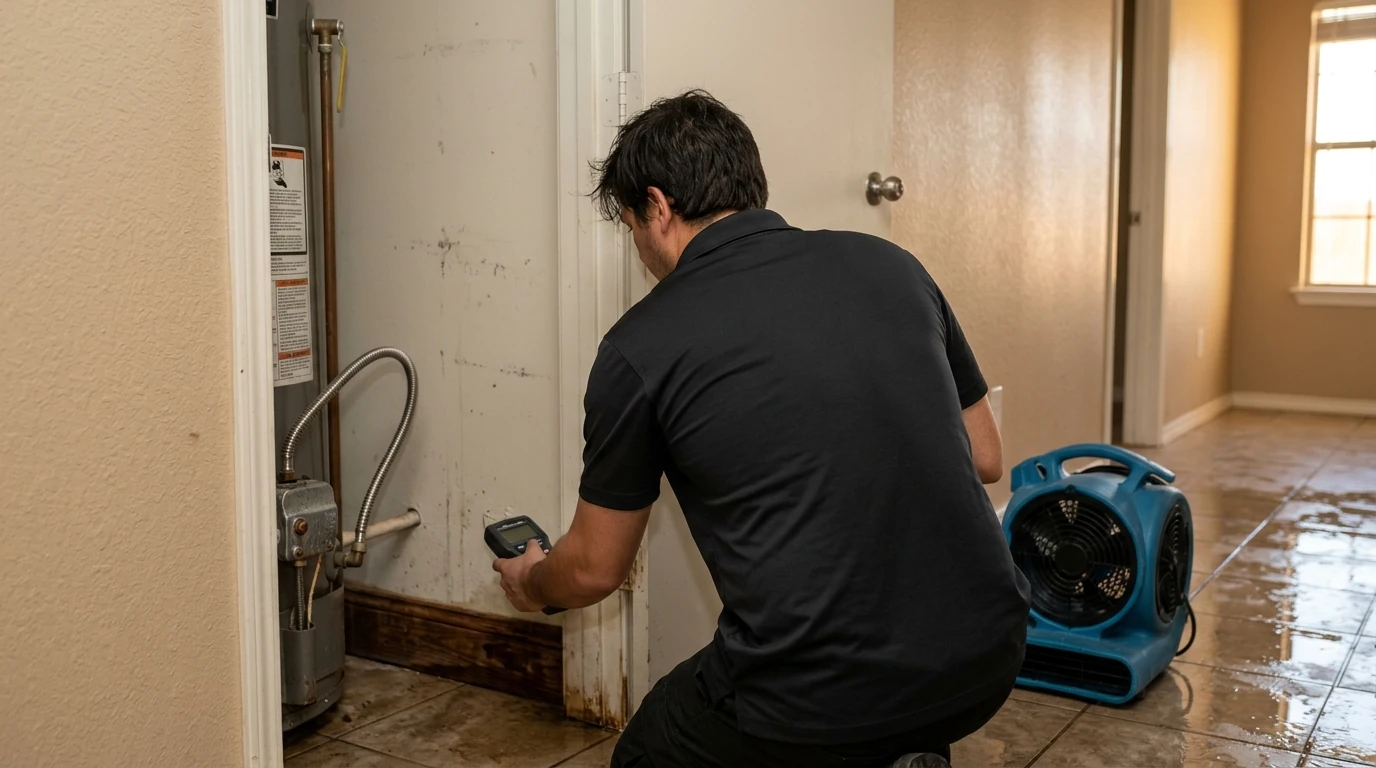
TL;DR: A water heater leak cleanup in Midland, TX typically runs $400 to $2,500 when the water stays on tile or in a closet and is caught within a few hours, and $2,500 to $7,000 or more when it soaks carpet, pad, and drywall across multiple rooms. Replacing the water heater itself is billed separately by a plumber, usually $900 to $2,200 installed. Most homeowners policies cover a sudden tank failure but not years of slow seepage.
If you walked into a utility closet or garage in Midland and found an inch of water around the base of your water heater, your first question probably isn’t “what caused this,” it’s “what is this going to cost me.” The honest answer depends on two things: how many gallons got out, and how long they sat before you found them. A tank that split and drained its full 40 to 50 gallons overnight behaves very differently than one that’s been weeping for an hour.
How much does a water heater leak cleanup cost in Midland, TX?
Most West Texas homeowners pay somewhere between $400 and $7,000, depending on how far the water traveled and what it touched. The table below shows typical ranges by scenario.
| Scenario | Typical cost range |
|---|---|
| Leak contained to closet/garage, tile or concrete floor, caught within hours | $400 - $1,500 |
| Leak reaches one adjacent room with carpet and pad | $1,500 - $3,500 |
| Leak sits overnight or longer, wicks into drywall and baseboards | $2,500 - $5,500 |
| Leak reaches two or more rooms, or a hallway connecting several | $3,500 - $7,000+ |
| Water heater is on an upper level or in an attic and leaks through a ceiling below | $4,000 - $9,000+ |
| Commercial unit or multi-tenant property with shared walls | Scoped individually, usually $5,000+ |
These are typical industry ranges for water extraction, drying equipment, and affected material removal. They do not include the water heater itself, which is a separate plumbing bill.
What actually drives the price up or down?
Four things move the number more than anything else: gallons released, hours before discovery, flooring type, and how far moisture wicked into drywall. A full tank failure found immediately on tile costs far less than a slow drip found two days later on carpet.
Gallons released matters because a standard residential tank holds 40 to 50 gallons, and a full rupture dumps all of it at once. Hours before discovery matters because drywall, baseboards, and particleboard cabinetry start absorbing water the moment they’re wet, and the longer that sits, the more has to be cut out and replaced rather than dried in place.
Flooring type is the other big swing. Tile and sealed concrete, common in Midland closets and garages, can often be dried without tearing anything out. Carpet and pad usually have to be pulled, and laminate or engineered wood frequently can’t be saved once water gets under it.
Does it cost less if the leak stayed in the closet or garage?
Yes, a leak contained to a closet or garage floor is almost always the cheapest version of this job. There’s less square footage to dry, fewer finished materials involved, and often no carpet or drywall base plate to remove.
Once water crosses the threshold into a hallway or bedroom, the job changes shape. Baseboards act like a wick, pulling water up into the drywall above the floor line. That’s the point where a technician will often cut a flood cut, removing drywall a foot or so above the waterline, rather than trying to dry it in place.
Why does drying take several days, and why do the readings matter?
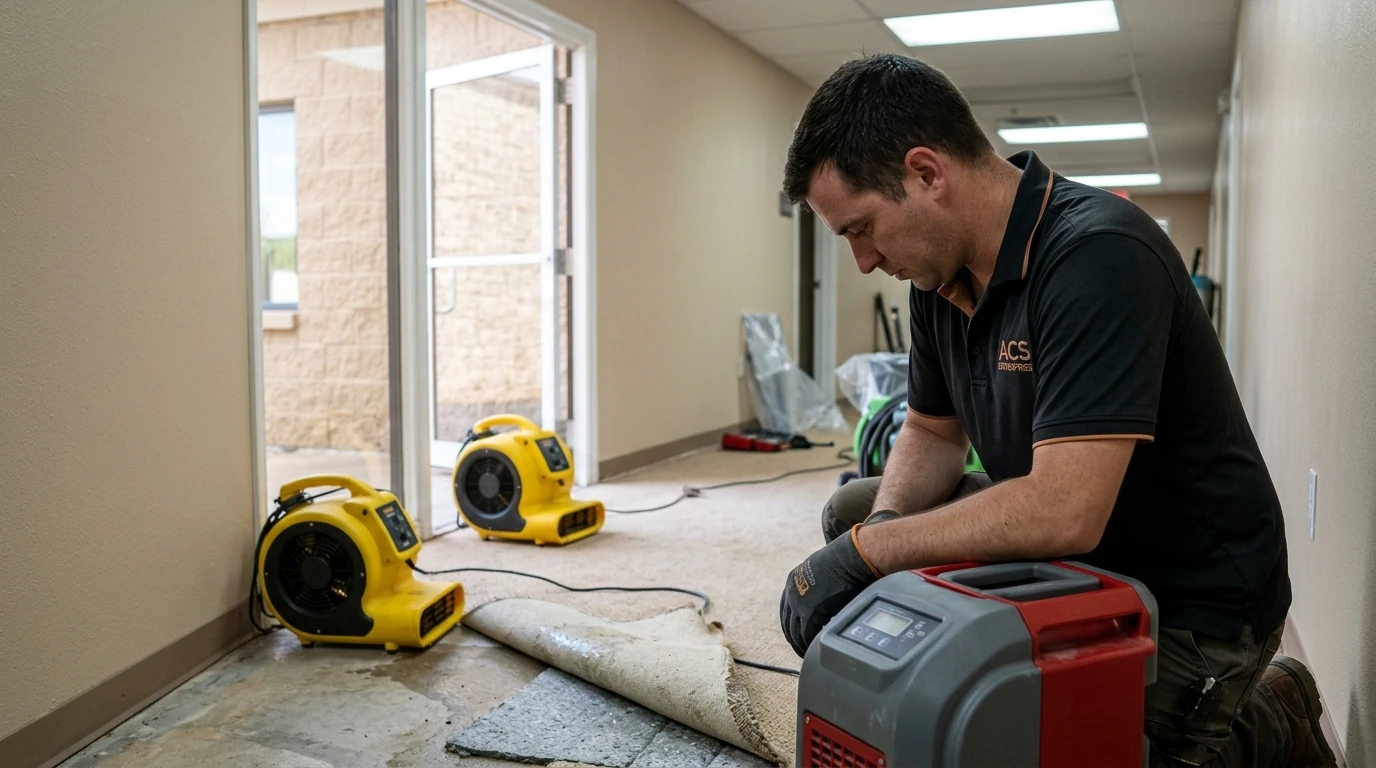
Structural drying for a water heater leak usually takes 2 to 4 days, and the daily moisture readings are what tell the crew when it’s actually done, not a guess. Air movers and a dehumidifier run continuously during that window, and a technician checks moisture content in the wood framing, subfloor, and drywall each day against a dry standard, following the ANSI/IICRC S500 water damage restoration standard.
Stopping early because the floor “looks dry” is how homeowners end up with soft spots in the subfloor or warped baseboards months later. The readings are the proof the job is actually finished, not just the visible water.
Is the cleanup bill separate from replacing the water heater?
Yes, cleanup and replacement are two different trades with two different invoices. A restoration crew extracts water, removes damaged material, and dries the structure. A licensed plumber removes the failed tank and installs a new one, typically $900 to $2,200 installed depending on tank size and code requirements for the new install.
Some homeowners assume one bill covers both. It doesn’t, and asking for a single combined quote from a cleanup company usually means they’re subcontracting the plumbing work anyway.
Will homeowners insurance pay for this?
Most standard homeowners policies cover sudden, accidental water damage, which includes a water heater tank that suddenly fails or ruptures. What they typically don’t cover is damage from a tank that’s been slowly leaking for weeks or months, since that falls under gradual damage and lack of maintenance, which most policies exclude. For a fuller breakdown of what’s typically covered and what isn’t, see our guide on whether homeowners insurance covers water damage, and check your own policy language or ask your agent, since terms vary by insurer. The Insurance Information Institute and the Texas Department of Insurance both have plain-English explanations of this distinction.
Documenting the loss helps either way. Photos of the leak, the water heater’s age, and the affected area before anything is moved give an adjuster what they need and protect your claim.
How do I keep the bill as low as possible?
Shut the water off at the heater’s cold supply valve the moment you find the leak, then photograph everything before you move a single box. Every hour water sits is an hour it keeps spreading and wicking into more material, so speed is the single biggest cost control you have.
Move boxes, furniture, and anything on the floor out of the wet area right away, and open closet doors and cabinet bases so air can reach hidden corners. If the leak reached carpet or drywall, a same-day moisture assessment tells you exactly how far it traveled before you decide what to tear out.
If you’re in Midland, Odessa, or anywhere in the Permian Basin and you’re standing in water right now, ACS Enterprise runs water heater flood cleanup around the clock and can request a water damage estimate or start extraction the same day you call.
A water heater leak is manageable when it’s caught fast and scoped honestly. The real cost driver isn’t the leak itself, it’s how many hours pass before someone with a moisture meter gets eyes on it.
About ACS Enterprise
ACS Enterprise has served Midland, Odessa, and the surrounding Permian Basin since 2019, with a 24/7 line and a 5.0 Google rating across 366 reviews. The company is licensed and insured, and its crews handle water damage restoration, emergency water removal, sewage cleanup, storm damage restoration, carpet and upholstery cleaning, and air duct cleaning across the region.
Need help now? Call ACS Enterprise at (432) 847-4704.