Water Damage Restoration in Midland
Water damage restoration in Midland and surrounding areas. Insurance billing accepted. Call (432) 847-4704.
Standing water moves fast. Within the first hour, it wicks into drywall, saturates insulation, and begins softening the wood subfloor beneath your feet. By 24 hours, what started as a burst supply line or an overflowing appliance can leave structural materials holding enough moisture to stay wet for weeks, even after the visible water is gone. Water damage restoration is the process of stopping that clock: extracting standing water, drying the structure down to safe moisture levels, and documenting every step so your insurance claim holds up.
What water damage restoration actually involves
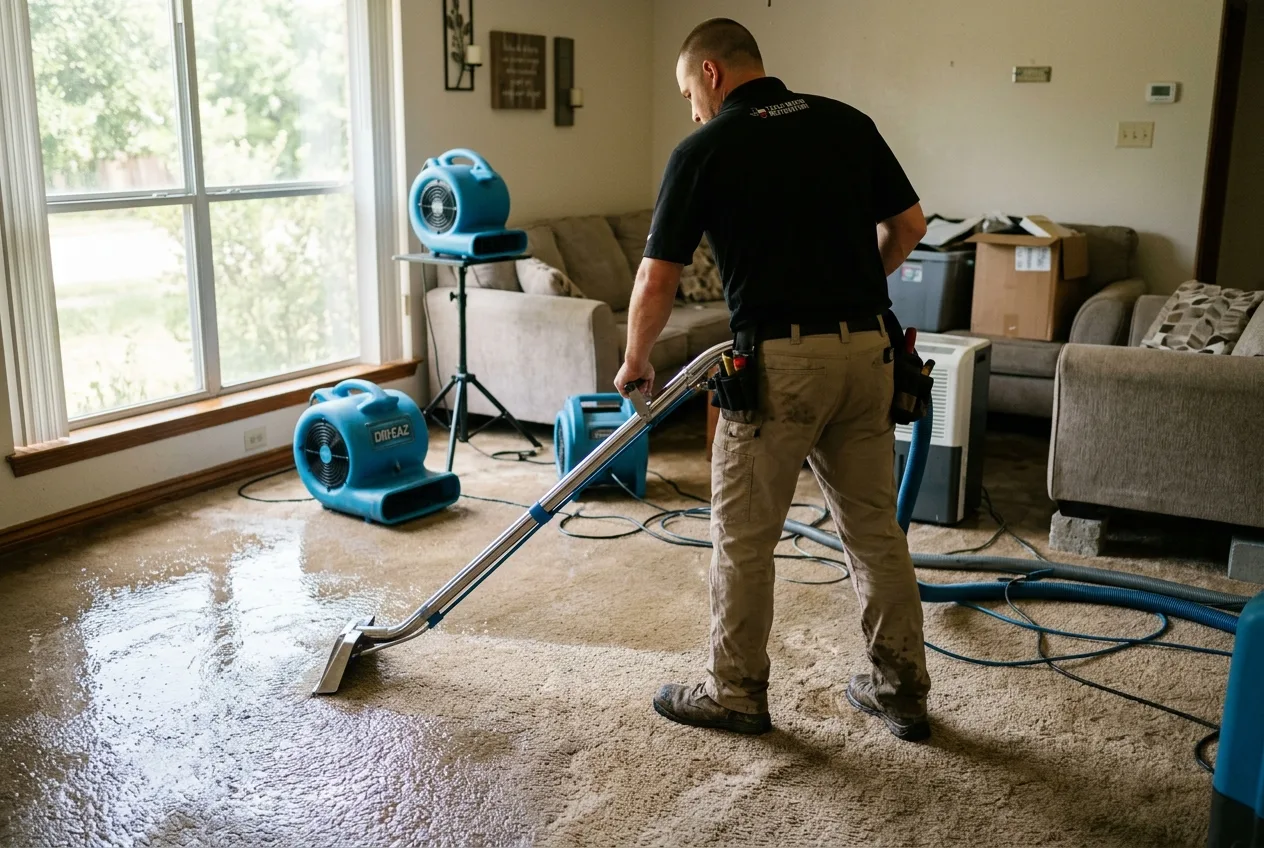
The work goes well beyond running a shop vac and setting up a fan. Professional water extraction uses truck-mounted or portable extraction units capable of pulling hundreds of gallons from flooring and cavities that a consumer wet-vac cannot reach. After extraction, the real work begins: industrial air movers and low-grain refrigerant (LGR) dehumidifiers create a controlled drying environment that pulls moisture out of wall cavities, subfloor assemblies, and concrete slabs rather than just drying the surface.
Moisture meters and thermal imaging cameras are used throughout the job to find water that has migrated behind baseboards, under tile, and into wall assemblies that look dry to the eye. A surface reading of zero means nothing if the lath behind the plaster or the OSB beneath the hardwood is still holding 25 percent moisture content. Drying to industry standards means hitting target moisture levels in every affected material, not just the ones you can see.
Timeline depends on the category and class of the loss. A small, clean-water spill in a single room may dry in two to three days. A Category 2 or Category 3 loss (gray water from an appliance drain or black water from a sewage backup) in a finished basement can run five to seven days or longer, with additional steps required to address contamination before drying begins.
Our process
-
Assessment and moisture mapping. Before any equipment is placed, the affected area is mapped with moisture meters and a thermal camera. This establishes a baseline, identifies hidden migration paths, and determines the water category so the right protocol is applied from the start.
-
Water extraction. Standing water is removed using high-capacity extraction equipment. Carpet and pad are evaluated: pad almost always requires removal and disposal because it retains water and cannot be dried in place reliably. Hardwood and tile are assessed for whether they can be dried in place or need to be pulled.
-
Containment and material removal where required. Category 2 and Category 3 losses require affected porous materials (drywall, insulation, wet carpet) to be removed before drying begins. Containment barriers are set where needed to protect unaffected areas of the home during this phase.
-
Structural drying with daily monitoring. Air movers and LGR dehumidifiers are positioned according to a drying plan. Moisture readings are logged daily at each monitoring point. Equipment is adjusted as materials dry down so the system stays efficient and drying does not stall.
-
Final documentation and clearance. When all affected materials reach their dry standard, final moisture readings are recorded and the drying log is compiled. This documentation is what your insurance adjuster needs to close the mitigation portion of your claim.
What separates a good water damage response from a bad one
The most common failure in water damage work is stopping too early. Surfaces dry faster than assemblies, so a wall can feel dry to the touch while the cavity behind it is still saturated. Operators who pull equipment based on surface feel rather than meter readings leave hidden moisture that feeds secondary damage for months.
A second common problem is skipping the moisture map at the start. Water follows the path of least resistance, which means it travels along floor joists, through wall plates, and into rooms adjacent to the obvious damage. Without a baseline map, affected areas get missed and never make it onto the claim.
Insurance adjusters look for a complete drying log: daily moisture readings at every monitoring point, equipment placement records, and photos of affected materials before removal. A restoration job without that documentation is difficult to supplement or dispute if secondary damage surfaces later. Thorough documentation protects the homeowner, not just the contractor.
What does water damage restoration cost?
Typical costs vary significantly based on the size of the loss, the water category, and how many materials require removal. Most homeowners pay somewhere in the ranges below, based on industry data, though every loss is different and ACS Enterprise provides a written scope before any work begins.
| Scenario | Typical industry range |
|---|---|
| Single room, clean water (Category 1) | $1,200 – $3,500 |
| Multi-room, clean water | $3,500 – $7,500 |
| Category 2 loss (gray water), single room | $3,000 – $6,000 |
| Category 3 loss (sewage or floodwater) | $7,000 – $20,000+ |
| Crawl space or basement flooding | $5,000 – $15,000 |
| Hardwood floor drying in place | $2,000 – $5,000 |
Homeowners insurance typically covers sudden and accidental water losses, such as a burst pipe or appliance failure, but generally excludes gradual leaks and rising groundwater. ACS Enterprise works with all major insurance carriers and handles the claim documentation on your behalf.
Seasonal and regional considerations
Midland sits in the Permian Basin, where the soil is largely caliche and clay. Heavy rain events, which do arrive in late summer and early fall, have nowhere to drain quickly in that soil profile, which means water pools against foundations and finds its way into crawl spaces and slabs. Older homes in established Midland neighborhoods were often built on slab foundations without vapor barriers that meet current standards, making them more vulnerable to moisture intrusion after any significant rainfall. Winter freezes are infrequent but sharp when they arrive, and supply lines in exterior walls or uninsulated garages are the most common source of freeze-related burst pipe losses in the area.
Service area
ACS Enterprise is based in Midland and serves the surrounding region, including Odessa, Andrews, Big Spring, and communities throughout the Permian Basin. City-specific pages cover local details for each area and link back here for the full process overview.
If you are looking at wet floors or water-stained walls right now, the damage is still spreading. Call (432) 847-4704 to schedule your moisture assessment and get a written scope before any work begins.
Frequently Asked Questions
Does homeowners insurance cover water damage restoration?
How long does structural drying take after a water loss?
What is the difference between Category 1, 2, and 3 water, and why does it matter for cleanup?
My floors feel dry. Do I still need professional drying equipment?
What should I do while waiting for the restoration crew to arrive?
Looking for the best water damage restoration company in Midland?
ACS Enterprise provides water damage restoration in Midland, TX and the surrounding area, and has served local property owners since 2019. Customers rate us 5.0 out of 5 stars across 362 Google reviews. We answer calls 24/7 — call (432) 847-4704 for immediate help.
Need Water Damage Restoration now?
We respond 24/7 across Midland and surrounding TX cities.
Related Coverage
- Our Restoration Services
- Contact ACS Enterprise
- Water Damage Restoration in Andrews
- Water Damage Restoration in Big Spring
- Water Damage Restoration in Gardendale
- Water Damage Restoration in Goldsmith
- Water Damage Restoration in Greenwood
- Water Damage Restoration in Odessa
- Water Damage Restoration in Stanton
- Burst Pipe Checklist: Step-by-Step Response
- What To Do in the First 24 Hours After Water Damage
- How To Choose a Restoration Company in (Without Getting Burned)