
Water Cleanup in Midland
Water cleanup in Midland and surrounding areas. Insurance billing accepted. Call (432) 847-4704.
Standing water does not wait. Within the first hour, it migrates under baseboards, wicks into drywall, and begins saturating subfloor materials that may look completely dry from above. By the time a homeowner has mopped up what they can see, the water they cannot see is already working its way into wall cavities and floor assemblies. Emergency water cleanup is the race to get ahead of that hidden spread before it turns a manageable water loss into a weeks-long structural drying project.
What emergency water cleanup actually involves
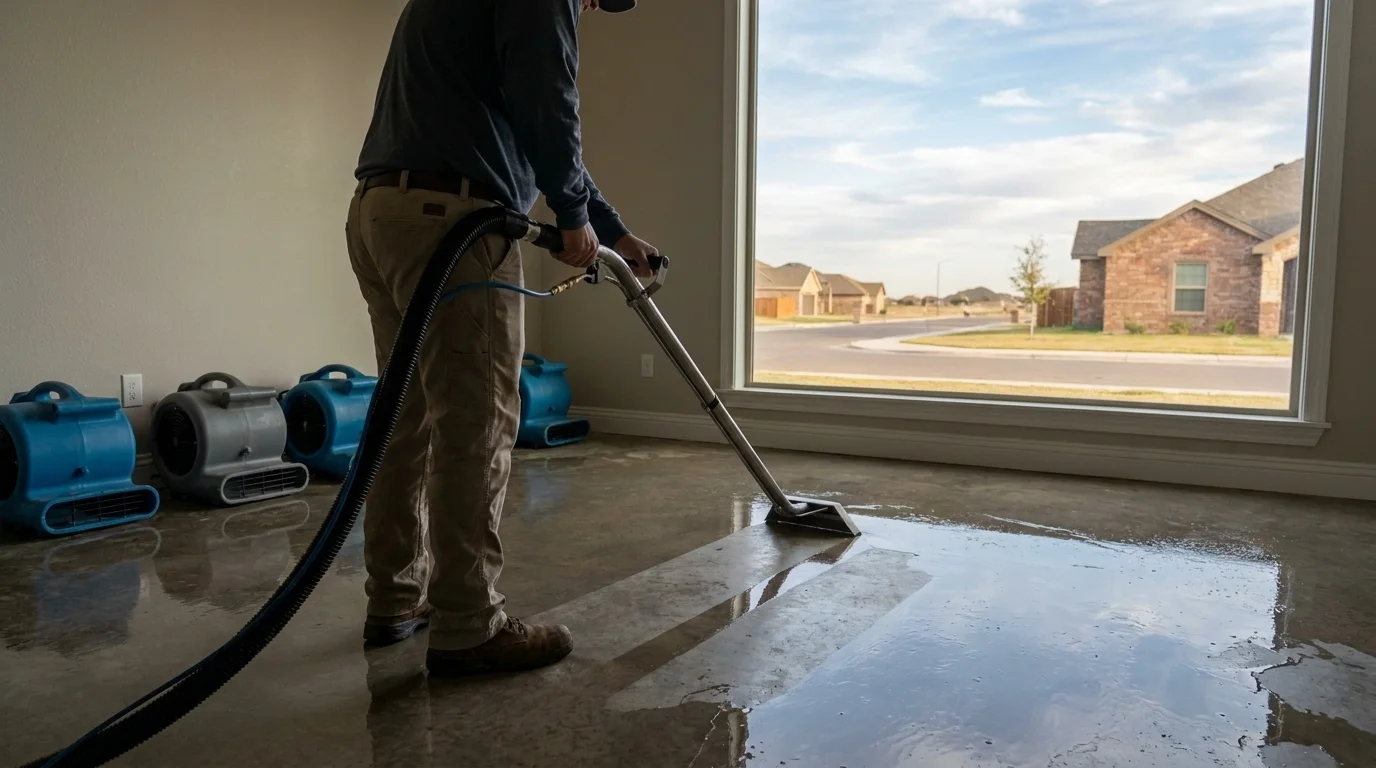
The work is not mopping and fans. Professional water cleanup starts with extraction, the physical removal of standing water using truck-mounted or portable extraction units capable of pulling hundreds of gallons from carpet, pad, and hard flooring before any drying equipment is placed. After extraction, the focus shifts to what the water left behind inside the structure.
Moisture meters and thermal imaging cameras reveal saturation in materials that read dry to the touch. Plaster walls in older Midland homes, for example, can appear intact at the surface while the lath and framing behind them hold significant moisture. Without mapping that saturation, drying equipment gets placed in the wrong locations and the job takes longer than it should.
Once the scope is mapped, commercial-grade air movers and refrigerant or desiccant dehumidifiers are positioned to create a controlled drying environment. The equipment runs continuously, and moisture readings are logged at each visit to confirm the structure is drying on a predictable curve. Drying typically takes several days, not hours, and the timeline depends on the water category, the materials affected, and how quickly extraction began.
Our process
-
Arrival and safety check. Before equipment enters the space, the source of water is confirmed stopped or controlled. Electrical panels near the loss are evaluated. Category 2 or Category 3 water (gray water from an overflowing appliance or sewage-contaminated water) requires a different containment and PPE approach than a clean supply-line break.
-
Water extraction. Standing water is removed using high-capacity extraction equipment. Carpet and pad are assessed: pad almost always requires removal because it holds water like a sponge and cannot be dried in place reliably. Carpet may be salvageable depending on the water category and how long it has been wet.
-
Moisture mapping. Every affected wall, floor, and ceiling assembly is read with penetrating and non-penetrating moisture meters. Readings are documented by room and material so the drying log reflects actual conditions, not assumptions.
-
Drying system placement. Air movers are positioned to move air across wet surfaces in a calculated pattern. Dehumidifiers pull moisture out of the air the movers are generating. In West Texas, outdoor humidity is often low, but indoor humidity spikes sharply during an active water loss and must be mechanically controlled.
-
Daily monitoring and documentation. Moisture readings are recorded at each check to confirm the drying system is performing. If readings plateau, equipment is repositioned or additional units are added. Final readings confirm that all affected materials have reached acceptable moisture content before equipment is removed.
What separates a good water cleanup response from a bad one
The most common failure in water cleanup is stopping at what is visible. A crew that extracts standing water, places a few fans, and returns in three days to check is not running a drying system. They are hoping. Moisture that is not actively being removed continues to move and to feed microbial growth.
A second common problem is skipping the moisture map. Without documented baseline readings, there is no way to know whether drying is progressing or stalled. Insurance adjusters increasingly require psychrometric data and daily moisture logs to support a claim. A job without documentation creates disputes at the worst possible time.
Category classification matters too. Water from a toilet backup or a dishwasher drain carries contamination that clean supply-line water does not. Treating a Category 2 or 3 loss the same as a Category 1 loss, without appropriate containment and antimicrobial treatment, leaves a contamination problem behind after the equipment comes out.
What does emergency water cleanup cost?
Typical costs for emergency water cleanup vary based on the size of the affected area, the water category, and how many building materials require removal or treatment. Most homeowners pay somewhere in the ranges below, based on industry data, but every loss is different and ACS Enterprise provides a written scope before any work begins so you know exactly what is being done and why.
| Scenario | Typical industry range |
|---|---|
| Single room, clean water (Category 1) | $1,200 to $3,500 |
| Multi-room, clean water | $3,500 to $7,500 |
| Single room, gray water (Category 2) | $2,500 to $5,500 |
| Finished basement or slab-on-grade with standing water | $4,000 to $10,000 |
| Sewage backup, partial area (Category 3) | $3,000 to $8,000 |
| Whole-floor event with subfloor involvement | $7,000 to $20,000+ |
Homeowners insurance typically covers sudden and accidental water losses, including burst pipes, appliance failures, and storm-driven water entry, though gradual leak damage and flood events from rising groundwater are usually excluded or require separate coverage.
Seasonal and regional considerations
Midland sits in a semi-arid climate, which creates a specific pattern for water losses. Plumbing freeze events are less frequent than in northern states but do occur during hard winter cold snaps, and when they happen the damage can be significant because insulation in exterior walls and crawl spaces is often minimal by northern standards. Summer thunderstorms in the Permian Basin can be intense and fast-moving, overwhelming roof drainage and window seals in ways that accumulate water quickly in attic spaces and along exterior walls. Slab-on-grade construction, common throughout Midland and the surrounding area, means water from a slab leak or a storm event has nowhere to drain and spreads laterally under flooring instead.
Service area
ACS Enterprise is based in Midland and provides emergency water cleanup throughout the Permian Basin, including Odessa, Andrews, Stanton, Big Spring, and surrounding communities. The city-specific service pages for each area link back here for full process and pricing detail.
If water is still moving in your home or building, the time to call is now. Reach ACS Enterprise at (432) 847-4704 to schedule your moisture assessment and get extraction equipment on the way.
Frequently Asked Questions
Does homeowners insurance cover emergency water cleanup?
How long does structural drying take after a water loss?
What is the difference between Category 1, 2, and 3 water, and does it change what gets done?
Can I run my own fans while I wait, or does that make things worse?
Why does carpet pad almost always have to be removed even when the carpet looks salvageable?
Looking for the best water cleanup company in Midland?
ACS Enterprise provides water cleanup in Midland, TX and the surrounding area, and has served local property owners since 2019. Customers rate us 5.0 out of 5 stars across 362 Google reviews. We answer calls 24/7 — call (432) 847-4704 for immediate help.
Need Water Cleanup now?
We respond 24/7 across Midland and surrounding TX cities.